

I Helped a $5K/Month Ghostwriter Grow Revenue Without More Hours | Jillian Richardson
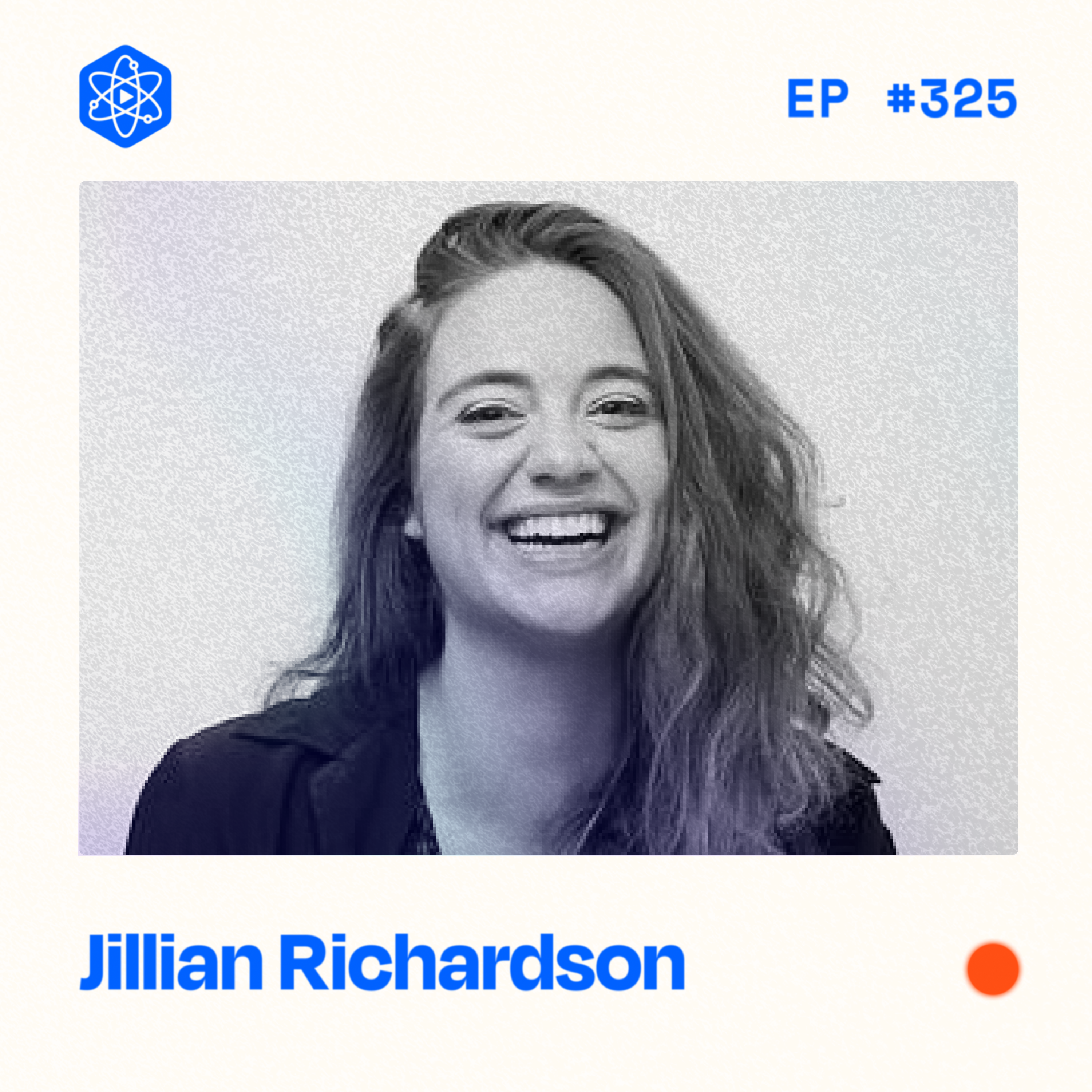
My guest is Jillian Richardson, a LinkedIn ghostwriter and the creator of Make LinkedIn Weird, a cohort that sold out its last three runs.
What you'll learn
- Why an alumni rate might fill her cohort faster than a discount
- Whether 10 students is really her limit
- How to run a Black Friday offer when everything you sell is your time
- The $9/month, non-community membership model I can't stop thinking about
About this episode
My guest is Jillian Richardson, a LinkedIn ghostwriter and the creator of Make LinkedIn Weird, a cohort that sold out its last three runs.
Jillian charges $5,000 a month for ghostwriting, which makes up about 60% of her income. The cohort brings in another 20%, and the rest comes from sample packs, profile makeovers, and coaching calls. She's happy with what she makes. The problem is that none of it is guaranteed past this month, and almost all of it costs her time.
Jillian is a member of the Lab, and she brought this to a live coaching session with me. This episode is that session.
By the end of this episode, you will know where to look for more revenue in the offers you already have.
Chapters
Mentioned in this episode
Full transcript
I'm happy with how much money I'm making every month, but the problem is even the thing that I charge the most for, which is LinkedIn ghostwriting, every month there is a potential for my client to cancel.
That's Jillian Richardson. She's a LinkedIn ghostwriter who charges $5,000 a month, and she runs a cohort called Make LinkedIn Weird. But none of her income is guaranteed past this month, and almost everything she sells costs her time. Jillian is a member of the Lab, my invitation-only community for 6 and 7-figure creators. She brought this to a live coaching session with me where we worked out how she can grow her revenue without working more hours.
The past 3, I have sold out at 10 spots. This one selling a little bit slower. If you were me, would you maybe just go back to past students and offer it again, offer it at a discount? What might you do?
Read the full transcript
You have 2 levers. You have bonuses or you have discounts. Discounting your time and delivery is not something I typically would recommend that you do. And ideally, like the best bonus strategies are things
Are there any other digital products you think that would really make sense for me to offer?
I'm very much enamored with the idea of a low-ticket, non-community membership that is asset-forward. There's a world where I subscribe to your thing monthly and I get a prompt from you every week via email.
Yeah.
If I subscribe annually, I get—
What? Your brain. So big.
All right, Jillian, what are we here to talk about today?
We're here to talk about how to make me lots of money, Jay. That's what we're here to talk about.
Let it fall from the skies. Okay.
Just let it rain upon me.
We can do this. We can do this. So, um, tell me current state of the biz.
Okay, so current state of the biz. I'm happy with how much money I'm making every month, but the problem is I mean, one, of course, would love to be making more. Also, I don't have a very recurring source of income. So even the thing that I charge the most for, which is LinkedIn ghostwriting, every month there is a potential for my client to cancel, which is something I could change. But as a service provider, I like giving them that opportunity. Like when I work with someone, it stresses me out if they say, you know, you have to work with me for 6 months now. Um, so that—
Okay, okay, okay. So we've got LinkedIn ghostwriting, that is one revenue stream. And what is—
That's my—
What's the price point on that?
Biggest source of income. So that is $5,000 a month.
Okay, what else are we selling? Tell me about all your wares.
All my wares. Okay, so I also offer a LinkedIn sample pack, I call it. Which it's usually the entry point into ghostwriting. It's a way for people to see if they like ghostwriting and also if they're a fit to be a client of mine. But it includes like a 90-minute coaching call. I make them a custom content strategy and I write them 3 LinkedIn posts so they can see like, do I even like the way Jillian writes for me? Do I like somebody else writing for me at all? And so even if they decide no, they have that. So that's the second tier. I've got LinkedIn makeovers where I rewrite somebody's LinkedIn for them.
Probably don't charge enough for that. I charge $250 for that.
What was the sample pack?
The sample pack was $2,500. Okay. Yeah, we got a lot of stuff. The LinkedIn makeover is $250. An hour of coaching is $300. Um, and then there's kind of my like signature thing that if you went to my LinkedIn, you would see me post about the most, which is my Make LinkedIn Weird cohort. And that ranges from $500 to $1,000 depending on how many add-ons people use.
Add-ons being things like hourly coaching or the makeover.
Yes. So it's, you can add the profile polish or you can add the profile polish and the makeover.
Okay.
So, sorry, the profile polish and the coaching call.
We have not talked about profile polish unless that is the makeover.
Those are the same thing.
Okay. Got it. Got it. Got it. Okay. So we have several different ways to hire Jillian. Yes. They're all, uh, with the exception of ghostwriting, which is month to month, the rest are one-time purchases.
How often do you run the cohort?
I run it like every other month.
So 6 times per year. Yes. Okay. Um, give me a rough proportion of, like, what is, what are these each contributing to the bottom line? Is like ghostwriting 75%? Is it 50%?
Yeah, I would say ghostwriting is probably 60%. The Make LinkedIn Weird cohort is around 20%, depending on the month. And then everything else is whatever fills the rest of that math in.
Okay. Are there any of these things that you personally enjoy doing remarkably more or remarkably less than the others?
Yes. Oh, and I will say also, After Make LinkedIn Weird, sometimes the students will purchase a coaching package of like multiple sessions at once. So it's kind of its own service, but it's the same as stuff we've talked about. But I really love doing the Make LinkedIn Weird cohort. It's the thing I get the best feedback on. I've talked to some companies about offering it to their employees. Nothing has happened there yet. Like, it hasn't landed.
But it feels like the most natural progression of like doing the same thing, but at a higher ticket.
And how many students do you typically have in a cohort?
10.
10?
Yeah.
Okay. Do you have any problem selling that cohort out when you run it?
Usually not. The past 3 I have sold out at 10 spots. This one, for some reason, seems to be selling a little bit slower. Um, but fingers crossed that will also sell out.
If you had 15 people who wanted to do it, would you make space for 15, or is there a capacity limit that necessitates—
There's a capacity at 10. I just think as one facilitator, 15 people would be too many.
Okay. Okay. Do you have people retake the cohort?
No.
Do you think any would be interested in retaking the cohort?
It's a good question. I have never asked someone that before.
It's a pretty common thing in cohort businesses that I see.
They'll have—
yeah, uh, they'll have so much so that a lot of them will have 2 different price points, uh, where they'll be like, it is $500 for a seat or it's $1,500 and you can join any future cohort.
Whoa. Okay.
But that doesn't quite work if you have clear capacity limits and you're limiting it at 10.
Yeah. Why is that?
Well, because let's say you've run 6 cohorts and you now have 30 people who have purchased the alumni tier that can come back anytime. And now your next cohort is full of 10 alumni and there's no, there's no new revenue from that cohort because alumni have taken all 10 spots.
Okay. So if you were me, would you maybe just go back to past students and offer it again, offer it at a discount? What might you do?
I would ask myself, I think this is the right lever to be pushing on, by the way, based on everything you've said so far. But I would say, okay, if this is $500 base level seat, what price point would make sense to put out there if you could then join any future cohort at the same price. Yeah. 'Cause there's 2 ways to do this. You could basically say, here's a higher upfront cost and you can do any cohort you want. Or you could say alumni get this price and they pay that price to rejoin any cohort. Yeah. The upfront cost basically says to the student, take all of the upfront risk, uh, because $1,500 only really makes sense if you plan to take the cohort 3 or 4 times over your lifetime.
And if you give them an alumni price, then they only pay for what they use, right? Okay. So it's a little bit more incentive aligned, but you're gonna capture less revenue upfront. But you could go to alumni for this next cohort and say, okay, it's $500 per person, but for alumni it's $250.
Yeah.
And if people buy it at $250, and that kind of tells you that, okay, well, people will take this more than once and they see the value in, uh, at least $250 worth to do the cohort again. And it starts to suggest what maybe the ceiling on your, like, uh, perpetual pricing tier could be if you wanted to make this a standing thing that people could buy ahead of time.
Okay. I like this. I like this idea because I've also had, and this might be going too far in a different direction, but I have had students say like, is there a way for me to continue to learn with you and the other people in this group in a continual way? Which would be a membership-based community, which is like your whole thing. That's one way. So I'm considering that as well, but that's just, that's so much work.
Yeah. And these, Let's put membership to the side for a second.
Yeah.
Because I think you could just basically use the same motion that you're already using. Mm-hmm. Uh, and these aren't even necessarily mutually exclusive. Like you could say, okay, make LinkedIn weird. Uh, it's $500 or $1,500 and you can come back for any past cohort.
Yeah.
But you could still go back to your past alumni and say, hey, if you wanna join this next cohort, we got a couple spots and for you it's $250 because you've already done this once.
Yeah.
Um, so you could, you could do a best of both where it's like, okay, if you're, if you're not confident that you're gonna wanna take it again multiple times, then just buy this seat. And then you'll still have the opportunity to join as an alumni later, maybe.
Yeah.
But I do think you'd have to solve this capacity issue. One, I'm also skeptical that you have a hard capacity limit at 10. I've run a lot of cohorts and I think, I think things, there, there are clear capacity limits at certain levels, but I would put them more in like the 30 to 40 person range for an individual. But I also don't know what delivery looks like on the back end. I don't know what, what level of personalization you're providing along with like the group coaching aspects of it.
It's definitely a lot of personalization. I'd say the last quarter of every class is hot seat coaching, which again, I could have a group of 30 people and still offer hot seat coaching, but I I do like it that every student is getting individual attention, probably multiple times throughout the course of the month.
I like that mindset.
Yes. Am I being too generous, Jay? Tell me.
I think probably yes for this audience.
Yeah.
Because there's a couple of different ways you can go about this. One, it's like you just don't paint the expectation that everybody gets individual attention, but some people will.
Yeah.
And here's the system by which we decide. Is it first come, first serve? Is it submitting something? ahead of time, is it literally buying a separate level that allows you that, that access? We ran a cohort this summer and it was, uh, $999 per person, but we had a second tier that was $1,999. And along with that, you got an extra weekly Q&A. So there was an extra weekly Q&A for that group that was an hour. No, it was 90 minutes. No, it was an hour. It was an hour long. But there was only like 8 people in that group.
So you got a lot of, you got a lot of time. So, you know, anytime that you're trying to grow revenue, it's better to look at like your existing products and say, okay, is there any recurring revenue possible here? Is there any expansion revenue possible here? And I think in your case you have both.
Yes.
Um, so I think you either change the expectations of the program in terms of like how personalized Your delivery is for the basic entry-level ticket.
Mm-hmm.
Or you have other team members, maybe alumni who help, help lead some stuff.
I, I like what you're saying because I was thinking when I do this in January, because I feel like January is a really big month for personal growth and new goals and all of that stuff, I want to change the way I run the cohort a little bit. So I could see it being the first hour is for everyone and the last half hour is smaller group, like Q&A style coaching, which totally makes me uncomfortable because I'm like, oh no, but then not everyone gets everything. But that's kind of the point.
That's why there are different prices for different offers. Like you're, you're making the program accessible at $500 a person. to get whatever promise, whatever like base level promise you're making from the program, you make sure that you deliver that to the folks who are buying the $500 ticket price.
Uh-huh.
As long as you're delivering on the promise, it's fine. If people want additional access, support, that doesn't scale. So how do we make those decisions? You could do a lottery system. Yeah. Or you could have like a separate tier of pricing. And I think most of the time people have a second tier of pricing.
I like this. And I think that also gives me a way to maybe sell this November cohort that's coming up as well, to be like, hey, this is the last time I'm running it this way, uh, like at this price point with this amount of access. So if you want it at this rate, you should join now. Or no.
No, that would totally work. So you could do this, you could do this, and it would totally work. Here's what would likely happen if you do that.
Great, great.
At any given time for our offers, there is some unknown invisible number of fence sitters.
Yeah.
And so by doing what you just described, you're gonna push a lot of fence sitters off into the pro category, which is good in November.
Yes.
And then the next time you do this in January, you might feel like this is harder than it was because you've like— You've emptied your fence sitters.
Mm-hmm.
So if, if the, if we're optimizing for near-term cash flow here in November, that would work. If we're optimizing for filling the cohort because it's harder right now, I would take the approach of going to alumni and trying this alumni rate.
Yep. I like that a lot. And you would do $250 versus $500 and maybe hope that they would add a coaching call or something like that as well.
The base seat is $500 for new folks.
Yes.
I would give the alumni a different rate.
Yes.
Yeah. And I would call it the alumni rate.
Right.
And I would do $250. And if, you know, let's say you're sitting here and you have 5 seats sold and you think you have a capacity of 10 and you suddenly have 7 or 8 alumni who want to do it again, I would Challenge yourself to flex your capacity because I think you could.
Yeah. Yeah, you're totally right. I'm just being a perfectionist overgiver.
And maybe I'm wrong and you'll talk to me in December and say, I totally burned myself out because I let in too many people and I knew my limits and you pushed me and how dare you?
Yeah, like I'm sobbing. Here's my therapy bill, Jay. I mean, wow.
Cards on the table, every time I've run a cohort, I leave that process exhausted. So, like, I definitely— I definitely push myself to say, I know running a cohort takes a lot of work to, like, launch and run. And so, I'm going to collect as much revenue as I can from it to my own health detriment.
You're like, my doctor says— Stop.
Take this with a grain of salt, um, but I think you could probably handle more than 10. I think you could probably go up to 20 and be fine. Yeah. And it's just a good test for the alumni version of this.
It's a good test. And also, this is really interesting to hear you say that the cohorts burn you out. I think because I've done this cohort, literally this will be my 9th time, I think, or 10th time. And I have the workbook done, the emails written, like all this stuff is already there. It's just the customizing it to the people that I have to do. So it feels very easy breezy to me.
You'll be great. I never have run a cohort more than once because I love shiny objects and I have like—
That's why you're like, we have to focus on the things you already have.
I think the first co— I think the cohort I did last December, we had like 50 regular participants and this one we did in June was like 80. So,
whoa.
And I was giving feedback on every piece of homework that was put in there. So
no wonder you were burned out. Good Lord.
But I'm just saying, like, I don't— I'm not asking you to go to that end of the spectrum. I'm saying from where I'm sitting, 10 people, I think you got more. And I don't think it'll be as painful as maybe you might think.
It's very fair. And also, I'm always surprised by how even with 10 participants, most people don't come every week. Um, so there's always going to be less than 10 people in the room with maybe the exception of the first week.
Yeah. I mean, if it breaks, we learn something, but like,
yeah,
it's kind of like when somebody is playing piano and you don't play piano and they make a mistake and in their head they're like, oh my gosh, everybody knows, but like nobody notices because nobody else plays piano. Like,
yes,
some breakages in the process you'll notice that other people won't, and you take note of it and you find a solution for the next time.
Yeah. Fascinating. Okay. All right.
I think that's what I would double down on as far as like the most obvious opportunity. Of course, like of these other things that you're offering, um, the makeovers, The coaching, the sample packs, all like all of these things are obvious expansion revenue possibilities for folks in the cohort that you can— you just need to make sure they know exist.
Yep. It's something the last cohort I learned this, I was like, oh, I should tell people not only should they get just one coaching call, they could buy multiple at once. And I made the package $1,950. And multiple people were interested. I was like, why was I not doing this before?
Yeah, you should talk about your offers more.
I definitely should.
That'll help. I would also be thinking about, and I know you are, uh, Black Friday's coming up. So you have this cohort that's going to run. What are the dates of the cohort?
Um, it is Tuesdays in November.
And will it end before Thanksgiving?
It will. It's the Tuesday before Thanksgiving is when it ends.
Nice, easy cutoff point where sell the cohort now to alumni, do a great job, and then think about after that cohort is over, what is the next step that you make available to these folks? And you can just position it as like, hey, I'm doing a Black Friday sale this year. I've never done it before. I have an offer for folks. I have like this thing that I'm selling generally, but also for folks who just did this cohort, here's a special Black Friday offer for, for just you guys. Yeah. Um, that's different or better in some way.
Do you have any thoughts of what that might be like? Is it a discount on the coaching sessions? Is it something else that you think might be intuitive naturally? Or next, I mean.
Well, the hard thing is all, everything you've described here has clear ties to your time and delivery.
Yes.
And so like discounting your time and delivery is not something I typically would recommend that you do. So it might be like almost inventing a bundle or a different product out of this. So
yeah,
like your sample pack is $2,500. It has 90 minutes of coaching, 3 posts and strategy.
I guess I do.
Maybe you say, because you just went through this cohort, you know, X, Y, and Z. So here's a descoped version of the sample pack that cuts out part of this that maybe they don't need.
Yeah. Like a self-guided sample pack, you mean?
Maybe, maybe that's, I mean, I would just, what I don't want you to do is discount your time. Uh, unless you want to do that because like people will always buy discounted time. But I would, I would look at this and say, can I create an offer that is still like pretty known and tangible to these folks by descoping one of these other offers or bundling a couple of these offers together? But even bundling doesn't really work when everything is, is your time.
Everything's time-based.
So I would probably look at what can I cut out of the sample pack that these folks might not need. To offer this at a, uh, a lower price point than typical.
Yeah. Interesting. And of course now I'm noodling. I'm like, ooh, what are also all the digital products that I could create in the new year? That's what being in your community, it's really helping me think about that.
I think you should probably have some product that does not have delivery on the backend. That would be good for you and your business.
You know, I do. Okay. I forgot to tell you, but it's very small. It's called How to Become a Comment Queen, and it's a recorded workshop on commenting strategy.
Okay. What's that price point?
$57.
Okay. Well, that's something you could just bundle onto these existing things. So like you, you could then say, do you think people coming outta the cohort will still need a makeover or is that? part of the cohort experience?
You— I think usually either people will buy it or will go through somebody's profile live in the cohort, so it's not urgent for them.
Okay. Because you have— having that product means you could do something like say, okay, if you want an hour of my coaching, which is usually $300, you can buy that. It's still $300, but you also get my comment queen.
You're so good at this.
And you could apply that same strategy to any piece of the sample pack that you wanted to break out that was still based on your time. You know, like, here's, I'll do a strategy for you and you get this comment thing and, and it's this price. Because Black Friday, it's like—
We like that.
You have 2 levers. You have bonuses or you have discounts. And because we're not discounting your time, we want to figure out a bonus strategy.
Yeah.
And ideally, like, the best bonus strategies are things that people have already Heard exist.
Yeah.
Because like, oh yeah, I've wanted that and I just haven't bought it. So now I get it with this. Great.
Like, perfect free thing. We love a free thing. Are there any other digital products you think that would really make sense for me to offer? I just haven't thought of, and you're like, this is so obvious. Why is Jillian not doing this?
I'm not actually great at ideating and inventing like low-ticket digital products. I should be better at this. Yeah. Like the most obvious thing is if we look at what you do with your makeovers or what happens in your coaching calls, you just look for patterns. Okay. Like, what are the patterns of the things that you end up doing over and over again with people who book these other services? And then say, okay, most people are struggling with this, so I know it's a problem. And I also follow a pretty regular process, standard process for solving it. So providing that then is also rife for a digital product of some kind.
Yeah, you just gave me an idea. You saying that, like, what's a problem I hear over and over again with my students and coaching clients? It's often feeling writer's block, or like they know that they have stuff to say, but they're really scared to get started. And so it's not an ideation of content thing, it's a fear thing. So I feel like maybe that could be something as well. Like, how do you even get over that fear to begin with?
I think you could do that. It's just like, how do you then deliver on that?
It's a guided meditation.
I almost like, as you were saying that, it sounded to me like maybe they needed some, some prompting or some guardrails. So could you provide some prompts or some guardrails? I mean, like a, a 201 version of this is to create some sort of responsive web experience where people give you a little bit bit of information underlying it. You have like the Claude API that's trained on some of your weirdness and like this plus that equals new thing that people can at least react to.
Yeah, I love that. And I mean, LinkedIn prompts, that's something a coaching client literally today, he was like, can you give me a prompt? I was like,
I think
you— and that made him feel comfortable, the prompt.
Okay, brand new idea for you. Are you familiar with Liz Wilcox? I had her on the podcast recently. She has—
No.
She has a $9 per month membership that is non-community based. She every week sends a newsletter template that people can use to send their own newsletters with. It's like a Mad Lib for newsletters. And I'm very much enamored with the idea of a low-ticket, non-community membership That is asset forward. So it's like, it's like, it's like very utility based.
Yes.
And LinkedIn prompts fits that model.
And what I like about that too is because when students join the cohort, they get a 30-day calendar of prompts and it's like prompts. And then here are links to examples of posts that do this well. And people seem to like that. So I could see continuing to do that of like, here's the prompt. Here's where you can get ideas from, and like a few of those a month.
Yep.
And then you have a whole backlog that you could give to people for free as a bonus.
Yeah.
Maybe. Question mark.
The way I'm thinking about this, this is, this is super under wraps because I haven't talked about this at all. There's a world where— Exclusive scoop. There's a world where, uh, I subscribe to your thing monthly and I get a prompt from you every week via email.
Yeah.
If I subscribe annually, I get the vault.
What? Your brain. So big.
Big brain.
Uh,
yeah, I think, I think that's a pretty interesting model. Now, would somebody after the first year continue to subscribe annually if they've already kind of reaped the benefit of the vault? I think they probably would because I think if you're doing a let's just use Liz's example. If you're doing a $9 per month membership, I know she does not actually discount the annual version of this. Uh, so 9 times 12 is $108. I believe she sells the annual version at $108, but then she adds some bonuses on top of it.
Yeah.
But there's also a world, like, uh, Polina Pompliano has a Substack newsletter that is like, uh, I forget, it's like $12 a month or something, or maybe like $10 a month. Um, but then you can join annually for $59 a year. So it's not like here are 2, here are 2 months free. It's here are 6 months free.
A lot of months free.
So I think it's really interesting and generous to have a low-priced membership that's low-priced on a monthly basis, but then the, yeah, the reason to subscribe annually is just like so obvious. And overall, the, the investment feels so low for the value that you're receiving. It's just easy for you to overdeliver on. Which means you're gonna have high retention, which means if you stay in the game long enough, this subscriber base should just grow over time.
Yeah. Ooh, I love that. And wait, are you about to do something like this? Because you said this is a scoop.
Yeah.
What are you doing?
We've been redesigning like all of our offers on the backend and it started with like the actual experience of the lab, which you've seen. And now we have like custom software for lab members, which I love. But, um, 2 things that I'm working on. One is like a responsive web app. Like it's, it's almost like a course because I'm educating and I'm teaching you what to do, but then you have to literally fill things in and then we get feedback based on our own AI training for what we're talking about.
Wow.
And so you end with a—
You use AI in a way I like.
Yeah.
Like this is, this is all good and fun.
So you end with like a very clear artifact of like, here is your plan.
Yes.
Um, but I am very much playing with the low-cost, non-community subscription idea as well.
Uh-huh.
Not yet willing to share what that is going to look like, but all of these things also, by the way, are just things that members of the lab get and you can just play around with if you want. But yeah, this is stuff I'm thinking about.
Man, and boy is being a member of the lab great. I love the lab.
Hold on, let me transition into the advertisement
Music. Hi, I'm Gillian Richardson, member of the lab. You should join the lab.
Yeah. So these are the things that we're thinking about. Um, these aren't live yet, but like, I think this is interesting, innovative places to play. And my whole thing has been like, I don't want to just like create a new thing that looks and feels like all the old things. I want to create a new thing that feels like a new thing. And it's taken some playing around to figure out what that is. But all of the sawdust of that playing around is like useful stuff that I can add onto your context and say, ooh, these things together could work.
Like, this could be a good thing. I do really appreciate how you're always trying to figure out how to add value to the members. It's very clear that that's front of mind for you.
Well, I think that subscription businesses are amazing, but only if people want to keep the subscription. So, like, you have to prove your value in a world where you have a subscription product, and the Lab is not a low-priced subscription product.
Mm-hmm.
I think it'd be easier to retain people on a $9 per month product that you can very easily overdeliver on. And I think providing, like, plug-and-play templates, very clear items of utility, it's a lot easier for people to prescribe value to that, even if they're not using it. It's like, I still got this in my inbox. But if you don't use a community, like, it's not obvious to you what value was there that you could have extracted, you know?
It's so valuable.
Well, I think, uh, I think we did it.
I think we did it. Everyone were like, we could go forever. And I'm like, actually, I think, I think you got it.
I mean, I'm sure there's like more that could be done, but I don't think, I don't have any ideas that I think are going to be better or faster or easier to action than the ones we came up with.
Yeah, I think you're totally right, because I mean, anything that's like trying to sell to corporate or whatever, it's such a long process versus these things are very short-term and doable.
Yeah, yeah. Well, let me know how it goes. I'm excited to hear how the experiment
goes. I will, and you bet I'm gonna put a post in the lab if So great, and I'll see you on Monday on our Black Friday call.
I'll see you on Monday.
Yay! All right, thank you.


