

My biggest failure in 2025 was thinking of 2025 as a failure.
Right now, you're reading the second draft of my year in review. The first draft could have been accurately summarized as, "2025 was a failure—but here's why it wasn't a total failure..."
After writing the first draft, I took a break and went out to my garage gym. It was leg day, and Claude has been helping me get back into strength training. By the end of the workout, I realized the tone of my review could (and should) be completely flipped:
2025 was a success—but here's why it wasn't a total success...
In many ways, that four-hour period was a perfect encapsulation of my year. Most of the time, my internal narrative was, "I'm failing," with intermittent positive experiences (read: allowing myself to experience good moments intermittently).
My negative attitude stemmed from one metric: revenue. 2025 was the first year since 2019 that the business didn't earn more revenue than the previous year. People often ask me about the step back in revenue in 2019—and the truth was, I realized the business I was running in 2018 wasn't the business I really wanted. I deferred near-term revenue in order to build a better foundation—which I'd say is also true of my 2025 approach.
From 2020 through 2024, revenue grew an average of 75% per year! I knew that trend would be hard to continue in a year when I expected to make some changes.
I wrote in my 2024 Year In Review:
I start every year with some level of fear that everything could go away and anxiety that there's no way I could match these results again next year. This year is no different! I have those same feelings.
But I'm attacking the year with enthusiasm while also recognizing that my priorities have changed. Of course, I want the business to continue growing, but I'm also not willing to sacrifice my involvement as a husband and father for that growth.
I regret to report that I still haven't quite learned how to simplify, work smarter, hire, or empower. That enthusiasm waned quickly as I continued my poor work habits in 2025, added more complexity, and suffered the consequences.
Those consequences are seen in our financials, yes, but they were even more apparent in the life side of my work/life balance ledger:
- Few date nights
- Little time with friends
- More daily stress
- Worse eating habits
- Minimal strength training
- Moderate weight gain
- Near-constant self-doubt
And yet, thinking of 2025 as a failure is a brutal and unfair assessment. If I give myself permission to look at the facts, this was a very successful year! We made some big investments in the future, including:
- Building a world-class, at-home recording studio
- Hosting our first 2-day, in-person member retreat
- Developing the proposal for a book I'm excited to write
Those were expensive endeavors in terms of time and financial investment. When you look at the numbers, they're captured in the costs of the year, but not revenue.
And yes, there were some big swings taken that didn't pay off. The results of those misses are seen in the business's bottom line. But if you reduce your judgment of success and failure down to your Profit & Loss Statement, you're bound to make poor life decisions. After all, if all you care about is your P&L, your decisions are going to be fully based in profit or loss!
For example, one of my big decisions this year was reducing sponsorship to allow myself the space to slow down publishing. I was sick of feeling like a passenger to my editorial calendar. Reducing sponsorship was a decision that I made. A decision that had an immediate tradeoff in revenue. Not a P&L decision, but a quality of life decision.*
A decision I'd make again!
Suffice it to say, my ninth year in business was mentally and emotionally challenging. I felt more anxiety, frustration, and self-doubt this year than any other (maybe more than all other years combined). When I'm properly rested, hydrated, and have had my exercise, my perspective is markedly different.
...but rest, hydration, and exercise took a back seat.
Our daughter (our first) was born in the summer of 2024. I took about three months off from work and then got back to "business as usual" in Q4 of 2024. In those final months, I didn't really make any changes to my work life—I simply changed my working hours and put a lot of pressure on my wife, Mallory (who is also a partner in the business).
The result was brute forcing a full, pre-baby workday into a post-baby world where I had fewer hours to contribute. Surely that's unsustainable—and, surely, I would need to make changes in 2025!
...but I didn't. I continued to rely on brute force, which both ground me down to a nub by the time Christmas rolled around and put a ton of pressure on Mallory.
Despite the challenges, I'll likely look back on 2025 as not only successful, but a pivotal year on which our future success depended (but was invisible at the time).
My hope is that this reflection is not a highlight reel (or a lowlight reel), but a useful accounting of what I experienced and—more importantly—learned from that experience so that I can help you skip over the painful bits.
Business
Revenue dropped about 8% while expenses grew 5%. This ended up being a smaller contraction than I expected, but I was anticipating that contraction all year. Which meant that—all year—I was telling myself that the business was shrinking, I was failing, and everything was surely going to go to zero.
Of course, that was an emotional reaction and not a logical one.
Here is a closer look at the financials this year and historically:
Financials
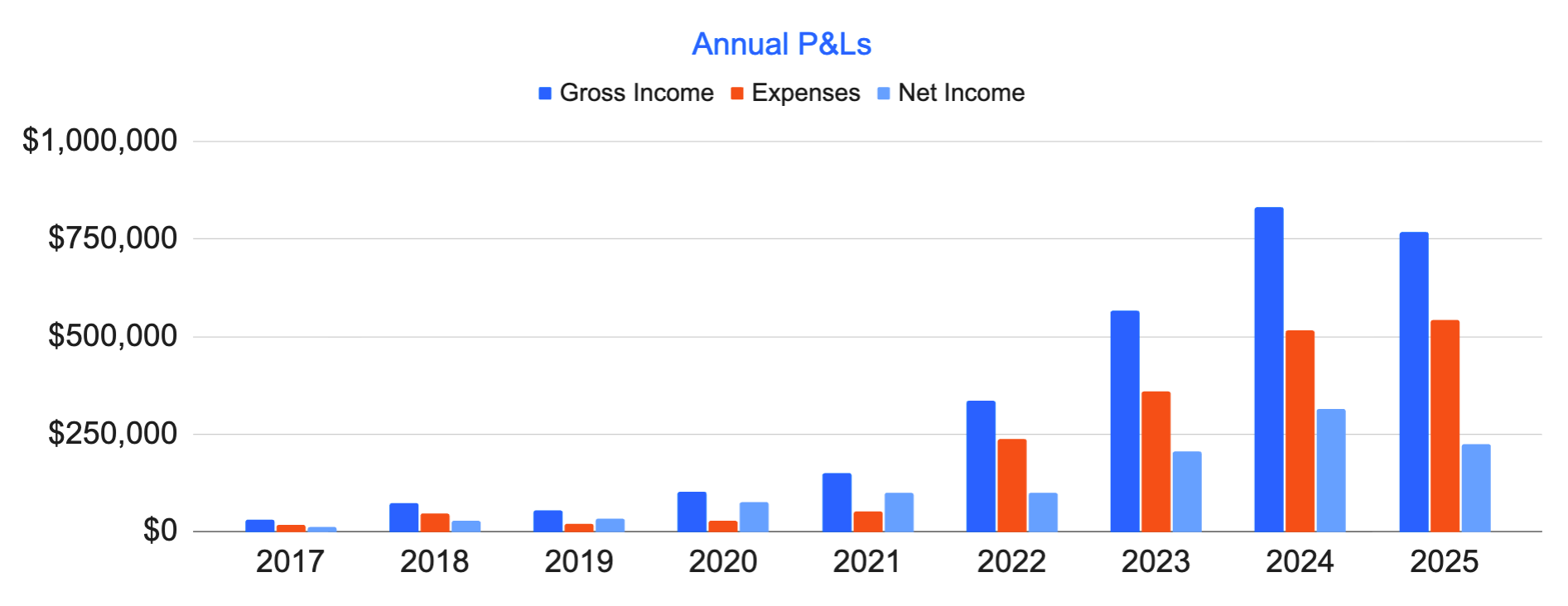
In 2022, I started filing taxes as an S-Corp and paying myself as a W-2 employee from the business. In 2024, my wife became a W-2 employee as well. So our expenses include our salaries, health care, and retirement.
Our main cost-drivers are:
• 50% payroll (salaries, health insurance, Solo 401(k)s)
• 25% contract labor (mostly YouTube-related)
• 25% misc (equipment, software, travel, etc.)
Outside of that, I’ve consistently hired more help for the business and experimented with one-off projects (like a developmental editor on the book proposal). I could save more money by spending less, but I enjoy using the revenue the business generates to invest in projects I think have future potential. The YouTube channel, in particular, has operated at a loss for most of its existence.
In reality, this macro revenue trend masks important, smaller truths:
- Membership revenue grew 18% ⬆
- Affiliate revenue grew 148% ⬆
- Sponsorship revenue dropped 38% ⬇
- Digital Products revenue dropped 74% ⬇
The sponsorship decline was two-fold:
- A choice to reduce sponsorships on YouTube and the podcast
- A reduction in AdSense revenue from a decrease in channel views
The digital product decline was a result of not launching any new digital products this year (after launching two in 2024).
None of these "failures" were a surprise—they were a direct result of choices that I intentionally made.
So why did they feel like such personal failures?
It comes down to a quirk of running a very meta business like mine.
Here's the truth: The more successful my business is, the more successful it becomes. I'm in the business of helping people grow businesses. If my business grows, so does my credibility. If it shrinks, so may my credibility.
This is great when things are good financially—growth begets growth.
So I feel constant pressure to prove my credibility through the growth of my own business. I also constantly fear that, if things trend in the wrong direction, my audience will seek out someone with a better track record.
When I see revenue declining, the fear part of my brain goes to, "This is the beginning of the end." Especially when I scroll my feeds and see others showcasing THEIR growth.
And here's where things get even more psychologically challenging...
From an engagement standpoint, sharing my financial wins is both 1.) high-performing content and 2.) drives more financial results (membership signups, course purchases, etc.). But...I'm tired of doing it. I think it's a short-term strategy that breeds envy and creates an appetite to see me fail. Not only that, but as time goes on, I find myself valuing privacy more.
The amount of public content I create showcasing my financial numbers has dropped to near zero. I share this in The Lab to be helpful, but it's simply not how I want to gain someone's attention or trust. So one of my highest-performing sales strategies has effectively disappeared.
Instead, I'm retooling my approach to better track, capture, and share customer success stories.
Let's dive into some more of the highlights, lowlights, and lessons learned this year.
Highlights
Finished the basement studio
In December 2024, we began finishing our basement. It was unfinished when we bought the house, but huge and dry. We designed it to include:
- A wet bar
- Theater room
- Reading nook
- Half bathroom
- Storage room
- And my basement studio
It's quickly become one of our favorite places in the house. You can view the whole transformation in my wife's "Basement" Instagram Highlight.
The studio is state of the art. It's sound-insulated, I work from a desk my dad built for me, and the whole thing comes alive with three switches.
Here's an overview:
Sponsor Magnet book giveaway
My bff Justin Moore published his book last year (crazy it hasn't even been a full year!) and I surprised him by purchasing 100 copies to give away to my audience.
It was a huge win-win-win for everyone involved—a natural way of supportive a close friend while also bringing value to YOU. Something I want to do more of.
Raised the bar on speaking
In January, Mallory, our 6-month old, and I flew to Dubai on Emirates for a speaking engagement and live podcast at 1 Billion Followers Summit. It was a once-in-a-lifetime experience!
Then in February, I flew to Austin to speak at Newsletter Marketing Summit, where my talk was rated the audience favorite.

And to top it off, I booked two $10,000 speaking gigs. I don't plan to do a ton of speaking (at least not until I have a book published), but it's nice to see that my perspective is valued. How did I raise my rate to $10,000? That's just the price I quote when I'm asked now. Because speaking is an expensive endeavor (the time to prepare and NOT be working), it's take-it-or-leave-it. And yes, many people choose to leave it!
Began taking the book seriously
At the same February event, I ran into my friend Anne-Laure Le Cunff, who was briefly staying in Austin. We talked about her book (she was actively promoting her launch of Tiny Experiments which is both fantastic and a huge success).
She made me feel much more confident that I was ready to take that step. Strangely, her agent (who I had previously spoken) had reached out that same day to see if I was thinking about writing a book. After some encouragement, I began speaking with developmental editors who could help me with my proposal.
The book has evolved several times already, and I turned in the latest version of my proposal to that agent just before Christmas. I'm so proud of the shape it's taken and I can't wait to write it. My gut tells me I'll go the traditional path, but I haven't closed any doors yet. It will depend on what the level of interest is, and whether I believe a publisher's offer indicates that they are truly invested in it.
Ironically, if the book had gone to auction in 2025, it may have been a higher revenue year than 2024—another example of how a lot of important work is invisible to the bottom line!
Major improvements to The Lab
Each year, I host a Town Hall to discuss the ideas I have, requests from the community, and then vote on our priorities to improve the experience. This year, we made several improvements:
- Masterminds—Small groups personally curated by me.
- Trusted Partners Directory—A listing of service professionals members have hired and vouch for.
- Lab Reports—Twice per year, we poll the community for "what's working" across various platforms and revenue models. We collate and summarize that information into a comprehensive report for members.
- Offline Events—We hosted our first two-day, in-person event in Boise. It was incredible (video below).
- Non-Business Initiatives—We implemented a Wellness challenge as well as a fantasy football league this year.
- Signature Product Bootcamp—A four-week, live course for developing YOUR signature product (that you can sell with confidence for years). This was available at no cost to members and those recordings now live inside The Lab.
We produced two new video assets for The Lab this year, including a video about our Offline Event and a new Trailer for the membership:
Personal brand project
Mid-year, as I began the book proposal project, I decided to dip my toes into Substack for my personal writing. At the same time, I re-engaged Hollie Arnett (she did the Creator Science brand) to help me with my personal brand.
This hasn't really been deployed yet, but I love it.

Explored larger partnerships
While I tightened the filter on which brands I'm willing to partner with, I began having deeper conversations with the brands I align most with.
One of those brands is Circle, who I partnered with on a free video course (not yet deployed) and a campaign in Times Square.
I also began testing more hybrid sponsorship/affiliate campaigns with companies like Tella and Senja. For these companies, I offer a lower sponsorship rate in return for the ability to use my affiliate code. That, combined with a special offer for my audience is a win-win-win.
I also had several conversations about partnership in return for equity. Ultimately, I want to go all in with one partner so I can really focus on moving the needle for them, but haven't found the right fit quite yet.
Lowlights
YouTube growth slowed
We struggled on YouTube this year. We entered the year with the plan for hiring more editors in order to increase output, but by October, we had published nine videos (fewer than any of the previous three years). Not only that, but we weren't executing on our strategy of tying the videos to a lead magnet to turn views into email subscribers.
Costs had increased, output and views had decreased.
Unfortunately, this meant restructuring our YouTube team, leaning out, and putting more work back on my plate to cut costs and try to fix the output problem.
Podcast listener decline
The more I focused on YouTube, the less attention I was giving the podcast. I was frustrated by YouTube publish dates getting pushed out and leaving a hole in the schedule for podcast episodes. To fill the hole, I was publishing episodes that weren't up to my standards. Unsurprisingly, the show declined in popularity.
This year, I'm renewing my vows to the podcast—the audio show—and having that clarity feels really good.
Light progress on email upgrades
For several years now, I've been telling myself that I need to beef up my email automation systems. I do a good job of identifying subscribers who may be interested in The Lab, CreatorHQ, etc., and then doing nothing with that information.
I did hire Jason Resnick for a few months who helped me implement some new systems (he's great) but I still failed to create or update the email sequences themselves.
Little outbound for The Lab
The culture of The Lab is really special. It's such a phenomenal group of GOOD humans who are ambitious, impressive, and yet still super grounded and kind. I talk to creators like that all the time! And when I explicitly invite them to join us, they often do. So why don't I do that more often?
Questioning my ambition
Amidst growth challenges, fear that sky is falling, and doomscrolling, I often questioned whether I was still ambitious. I've always believed I was a striver—and that I was destined to do something great. But as my work time has contracted, I've realized that my current lifestyle design does not give me an edge to win in most arenas of ambition.
And I'm mostly fine with that!
Of course, I want to be remarkably successful. But I want to do so on my own terms. And those terms mean I have to be more thoughtful about the games I play and my approach to those games. The truth is, I used to derive my sense of meaning and purpose from the work—but now it's from my family. It's difficult to compete with those who are willing to utilize more hours of the day.
Before we had our daughter, I worked 10-12 hours/day at least 6 days/week.
I worked a lot.
If I'm realistic about my working hours now, they're actually much lower. I work 6-8 hours/day and really try to limit it to 5 days/week. So I took 60-72 hours/week and turned it into 30-50.
But that's keyboard time. It's nearly impossible for me to shut my brain off, which means any hour I'm awake, I'm likely to be doing something that looks and smells a little bit like work. So, despite truly "working" far fewer hours now, my work brain still feels equally (more?) taxed because I'm thinking about work and anticipating when I can get back to the keys.
Lessons Learned
Every month the business exists, the stronger our future
Over the years, I've built really strong savings habits. Each month, I'm contributing to Solo 401(k)s for both my wife and me. I'm investing in a little bit of crypto, a brokerage fund, our daughter's college plan, and the business's savings are growing too. As long as the business earns enough to cover our current expenses and savings, our future becomes stronger with each month that passes—and that's an incredible feeling.
I am (still) the bottleneck
I've built some processes for repurposing some of my long-form content this year (shoutout to Laura and Izzy) but I'm still the bottleneck on much of it. When I stepped back in as producer on the YouTube channel, that was a significant commitment of time, too. Even if I'm not going to hire full-time (the current plan), I could still be doing a much better job of outsourcing.
But lately, I've been wondering if team-building isn't like family-building. Having a child has certainly increased my responsibility and pressure to provide, but it's brought so much fulfillment. I would make that decision 10 out of 10 times. Maybe building a business with full-time employees is similar?
A week off goes a LONG way
In March, I was planning to attend Sponsor Games, but got sick the night before. I had blocked off the whole week for the event, so suddenly I had a completely open calendar. I got so much done—it reminded me that my time belongs to ME and if I proactively block out a full week every ~6 weeks or so, I make a lot of progress.
Event economics are hard
We very nearly lost tens of thousands of dollars on our Offline event in Boise due to me personally guaranteeing a certain number of room nights to the hotel (and doing poor math). Thankfully, we did fill those rooms, but it could've been bad. At the end of the day, the event (which I intended to break even) still lost a few thousand dollars. Another Offline event in Columbus actually lost more money due to renting an entire restaurant and selling fewer tickets than anticipated. My planning estimates proved to be too optimistic.
→ Full breakdown of our Offline event here
Social media does, in fact, matter
In May, I published a video declaring, "I think I'm over social media." The thesis was that I had enough email subscribers and podcast listeners that if I just focused on long-form content, the business would be fine. That may be true, but if so, I should've increased publishing on those channels. The result was June and July were two of our three-lowest revenue months. It likely wasn't purely due to posting less on social media, but I do believe being top of mind matters a lot. If people aren't thinking of you, they aren't going to buy from you. So if you're going to publish less on social, you need to think about how you continue to stay top of mind.
Black Friday member renewals
Last winter, my Black Friday promotion was a push to get people to try the Lab's Basic membership. It was really successful, driving ~$25,000 in revenue. But a lot of those new members never really gave it a chance, which meant few of them renewed this year. Black Friday is a great time to drive purchases, but I wonder how many of those purchases end up being truly valued.
Health problems feel like business problems
When I neglect my health (exercise, diet, hydration) it has a profound impact on my psyche. And because I'm constantly thinking about the business, these things get conflated. Poor brain chemistry mixed with thoughts of the business became anxiety about the business. Purely because I wasn't moving my body.
Too many monthly goals
I set goals each month related to my financials, publishing, operations, and life. Looking at those goals in retrospect, I have about a 50% hit rate, meaning I set too many goals. Not only that, but I set these goals without really aligning my behavior or to-do list to them. That's not goal setting as much as it is dreaming.
Social never makes a negative headspace better
When I'm feeling down, it de-motivates me. When I'm psychologically uncomfortable, I seek out distraction. The habitual distraction is my phone (and social media). This never makes me feel better. I recently heard some describe scrolling a social media feed as scrolling through different emotions, because successful content is designed to evoke some emotion from you. It's like playing the slots for emotions—we hope it makes us feel good (and sometimes it does)! But that's the rare, variable result—not the typical one.
Personal
Highlights
Baby is walking, talking, and ruling the home

Our daughter seems to be reaching milestones at a blistering pace. One day, she wasn't walking, and the next day she was! The next day she was walking even more. And within just a few days, crawling was done.
Watching her develop is the highlight of our days. Thinking about how she sees the world is so grounding and refreshing. One day, she was eating an assortment of fresh produce including both strawberries and tomatoes. She loves strawberries, but this was the first time having a tomato. I'm not sure she really could tell the difference when she picked the tomato up, but her face told the story: she was not into it!
Can you imagine being unable to accurately anticipate the taste of something? How long you're going to be in the car? When someone is coming to check on you? It's crazy. She lives in a constant state of uncertainty, but she doesn't really know or understand that. Giving her a safe, loving home and seeing her live fearlessly is just the best. There is no better antidepressant than your kid spontaneously smiling at you or giving you a hug.
In-person retreat in Arizona
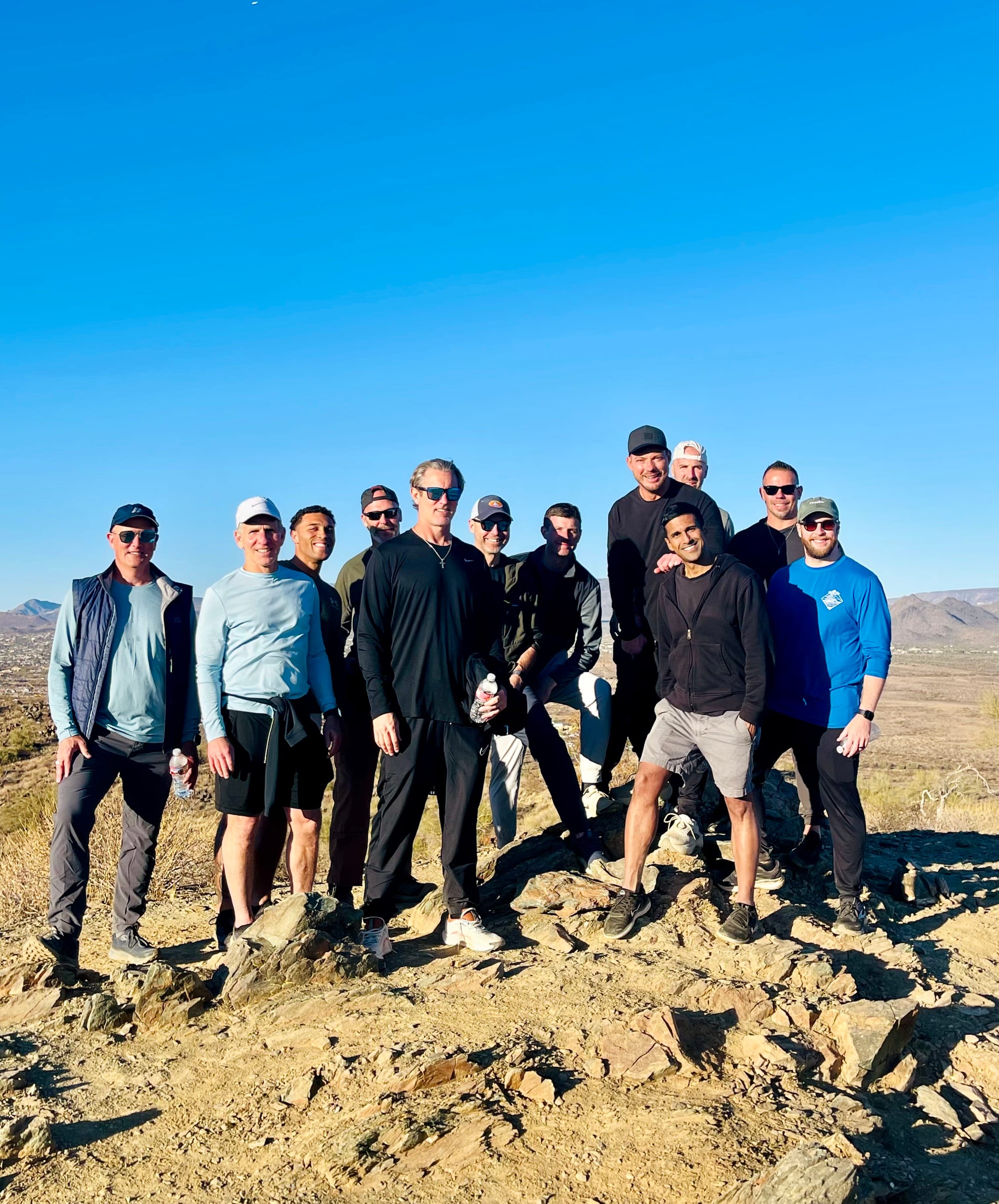
My friend Ryan Hawk put together an in-person retreat in Arizona, where I felt totally out of place. These were leaders in professional sports, Fortune 500 companies, and the military. Each night, we had "threaded conversations," which were a conversation amongst the entire group of ~16 of us, one person speaking at a time. It was amazing! The breadth of experience and perspective was something I rarely get to be a part of.
It was one of many reminders throughout the year that if I enjoy an experience, I shouldn't just wait for an invite—I should plan them myself.
I fell back in love with reading
Working on the book proposal was the nudge I needed to change my information diet. For years, I've been living on mostly podcast, YouTube videos, and social media. That means that the majority of my information intake was from media made in the very recent past, which makes it relevant but maybe not evergreen.
Reading books helped me understand structure, research, and depth. A 45-minute podcast typically has a ton of waste. But a book has been edited and edited and edited down to a much more dense, rich experience. The information you consume is upstream of your thoughts and how you experience the world. By consuming information different to what others in your space are consuming, you will have different thoughts, ideas, and approaches too.
Family Travel
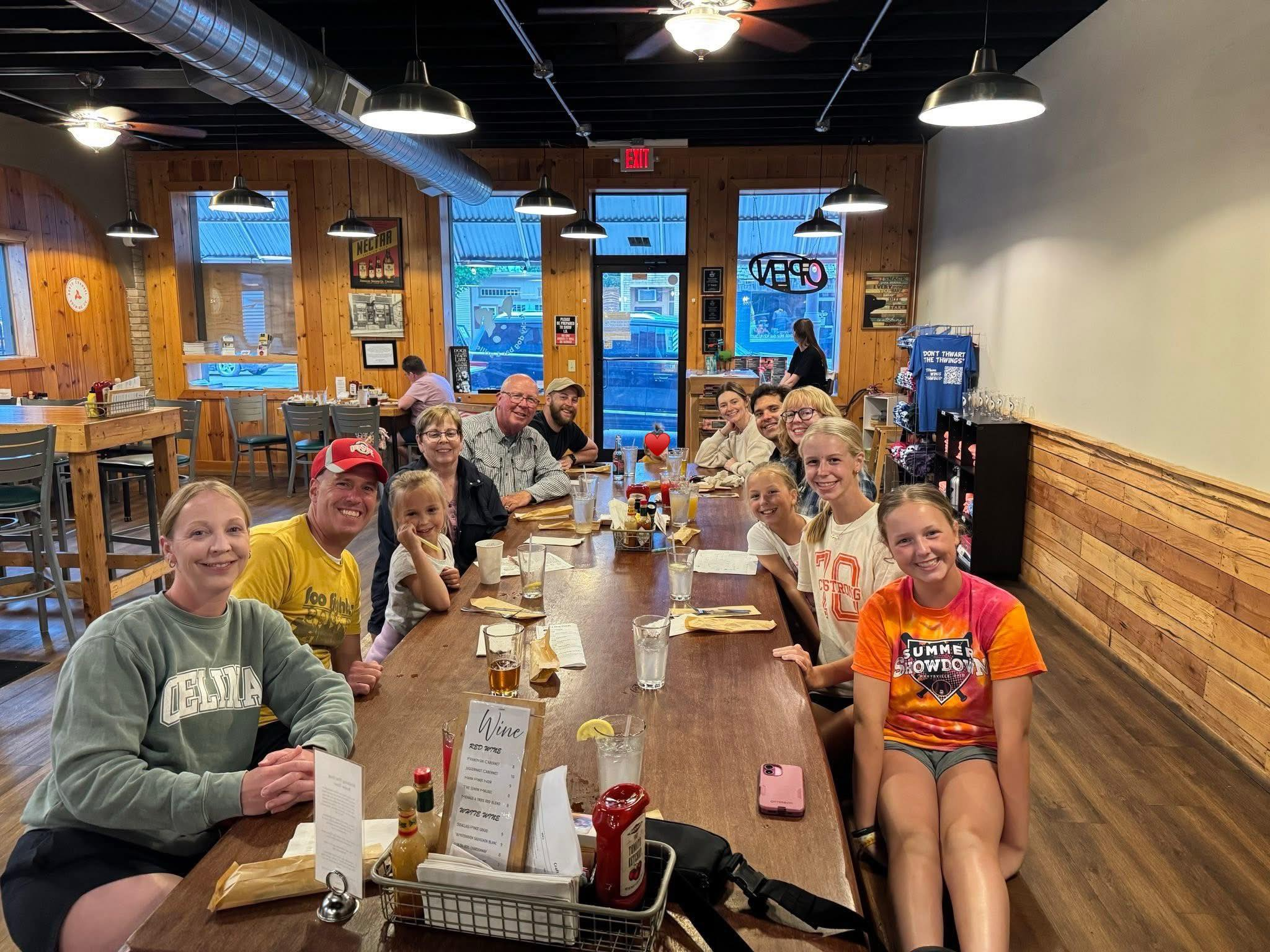
I didn't spend as much quality time with friends and loved ones as I'd like this year, but it wasn't a total loss. We had an amazing family trip to Michigan (we rarely have our whole family together) and I went on more fishing trips with my dad—an annual tradition I really value.
This was our daughter's second Christmas, but really the first one she seemed to experience. By celebrating at home and with each of our families individually, we had three Christmases, all of them special.
Quality Time with Mallory
When Mallory and I have made space for quality time, we've really loved it. With the new basement theater room, we've had a lot of movie nights, series we've gotten into, and even games that we play together. We loved It Takes Two.
We tried to make the most of our business travel. Dubai was challenging because the timezone change had baby sleeping during the day and awake at night. But we brought my mom to Boise with us and were able to get away for a dinner date.
She also planned an amazing birthday dinner for me in July. The food was so good it literally left us in tears.
Lowlights
Not enough time with friends (or making friends)
Earlier I noted that the longer the business exists, the better we're securing our future. But this goes beyond money—yes, I'm saving, but the business is also a fantastic vehicle for building relationships. Those relationships compound just like money, but in more unexpected ways. I should be spending far more time meeting people and building those relationships, but I often de-prioritize this for more "urgent" content creation.
The world feels unkind and uncertain
I pay little attention to the news, but sometimes it's unavoidable. The news this year has been noticeably more hellish. I don't approve of our leadership. And even if you do, it certainly doesn't feel like kind leadership.
The world also feels incredibly uncertain. We're in a privileged position, I've been staying on top of AI (relatively speaking), but I really worry about where things are headed. Not because I believe a superintelligent AI will destroy us, but because I think we will see massive job loss. With so many people operating on thin margins as it is, this could be a huge, huge problem. It feels like a collision course that should be humanity's primary focus in planning for, but that's not happening.
Neglecting my health
I've already spoken about this a few times, but I really didn't take care of myself this year. Besides moderate weight gain (185 → 195), my stress became particularly bad at the end of the year when I decided on October 28 to organize and run a cohort program in December. It caused a stress response in my skin, which was a wake up call to slow down and take care of myself.
Constant self-doubt
I tried a lot of new things this year. The book is an obvious one, changes in The Lab, taking time off of social, organizing in-person events...
All of these first-time experiences came with a dose of fear and uncertainty. Is this any good? Will this work? Is this the right move?
It's good to push yourself out of your comfort zone. But I was out of my comfort zone so often that I was constantly doubting myself, which had a spillover effect into areas of my life that I had been previously confident.
Lessons Learned
Be explicit about on-and-off times
Because my wife and I work, live, and care for our daughter at home all day every day, we often struggled to be fully IN or OUT of certain activities. For example, if we're both in the living while our daughter is playing and she needs a diaper change, who jumps in?
If she was independent playing and we're both working on something, this feels like an interruption to both of us, which can trigger a small amount of scorekeeping or resentment. What we learned to do was explicitly call out when someone is "off the clock" for baby duty so that they could, guilt or stress-free, engage in work or self-care.
What's the generous approach?
If I’m making a decision (especially one involving someone else) I try to take the more generous route. I have a tendency of keeping score and taking my own side—trying to achieve the convenient outcome for me. To counteract that, I'm asking myself to instead find opportunities to be more generous, even if it causes me minor inconvenience.
This also applies to how I interpret someone else's words or behavior. Instead of assuming the worst, I try to assume the most generous interpretation of their actions. Maybe they weren't being hostile or malicious, but simply thoughtless.
We need more reliable support
We have a dream scenario where we can completely control our own schedules without much worry about budget. We want to be home with our daughter instead of sending her to daycare. But we also realized this year we need more support.
It's far too easy to neglect ourselves or our relationship in order to care for our daughter and the business. Our parents have both been incredibly helpful, but they're too far away to spend as much time here as we'd like. We found a nanny and she's starting tomorrow.
The effects of neglecting my health are gradual but massive
They say a frog won't jump out of a pot if the water is boiled slowly—gradual changes eventually lead to the frog being boiled alive.
Neglecting my health felt like that. Slow, creeping, gradual tradeoffs that accumulated over months were much worse than I realized at the time. I need better systems for identifying those trends and making changes earlier.
Conclusion
This exercise was super helpful for me. I carried such a negative, unhelpful narrative all year—but looking more closely at the facts tells a different story.
Yes, there were some challenges this year.
Yes, we took a step back in some areas.
But it was a really productive year. It laid a lot of groundwork operationally and even psychologically. Not only did the business help a lot of people and further strengthen our future as a family, but it also helped me grow a lot as a man.
I now believe 2025 was an important, pivotal year. All of these highlights and lowlights may get compressed into thinking, "2025 was the year I began taking writing seriously." And that's enough!
